
Relief from TMJ, jaw pain and facial tension
Jaw pain rarely stays in the jaw. It travels into headaches, ears and the neck — and the assessment that finds why is the one that looks at all of them at once.
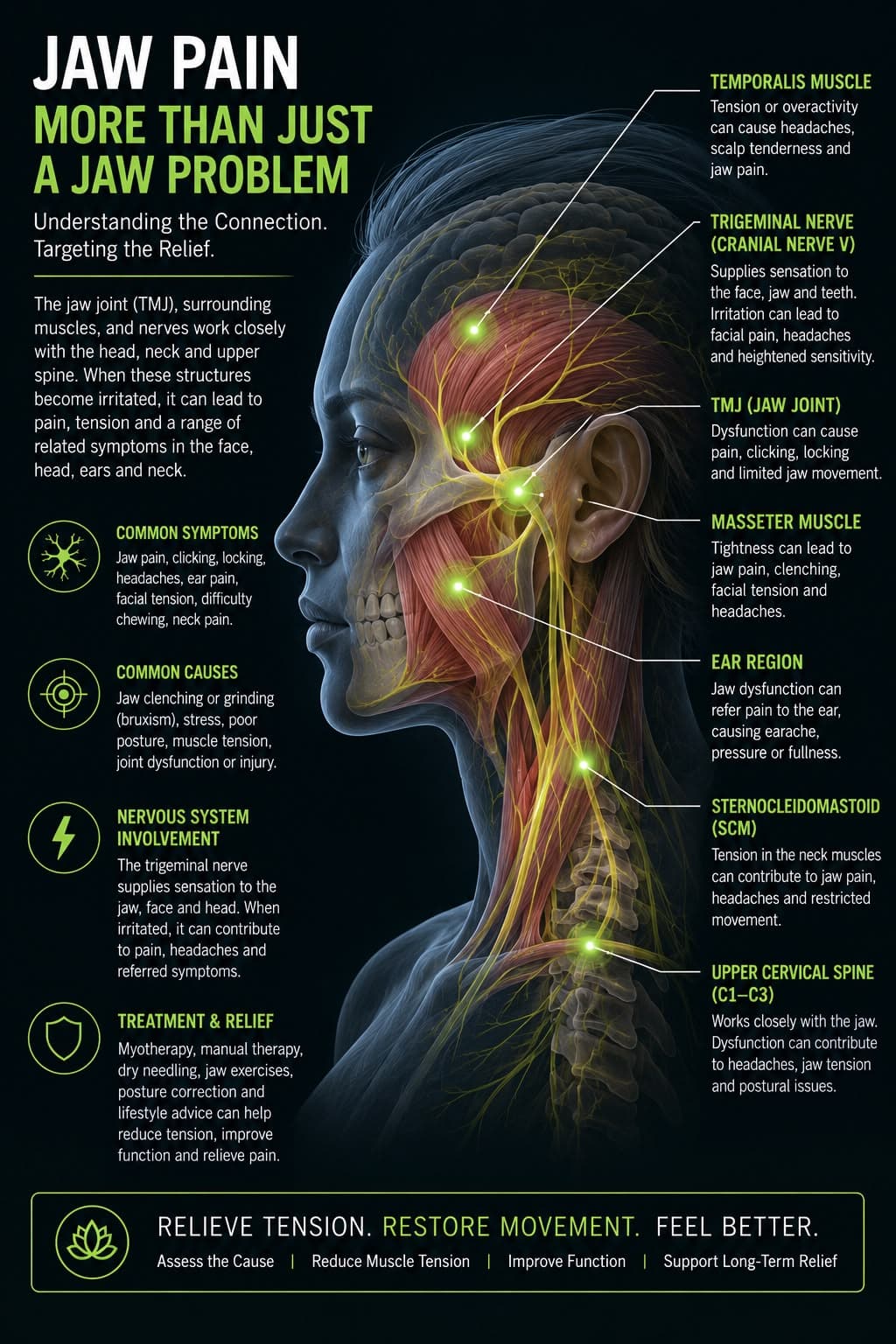
The short version
- TMJ is the joint. TMD is what happens when that joint and its muscles stop working properly.
- Tight jaw muscles compress the trigeminal nerve, which is why headaches and migraines follow.
- Tinnitus and ear fullness are often jaw-related ear dysfunction, not an ear problem.
- Most people notice relief within one to two weeks, with substantial change by six.
Specialised assessment and treatment for temporomandibular joint dysfunction, headaches, migraines and cranial nerve pain. The aim is to identify the root cause of your jaw tension and clenching rather than chase the symptom that hurts most on the day.
What we treat
- Temporomandibular joint disorder
- Jaw clenching and bruxism
- Facial pain and tension
- Migraine and tension headaches
- Tinnitus and ear-jaw dysfunction
- Cranial nerve sensitivity
Why assessment matters
Jaw pain connects to far more than your teeth. TMJ dysfunction is not simply a dental issue. The jaw is surrounded by muscles, nerves and connective tissue that link to your neck, shoulders and head. When the jaw is misaligned or tensioned it can trigger migraines, ringing ears, neck pain and even postural problems throughout your entire body.
Our assessment examines the whole system, not just your jaw joints. We look at muscle tension patterns, cranial nerve function, bite mechanics and cervical spine alignment to find what is really driving your symptoms.
Three key areas: jaw, facial and cranial
Jaw pain rarely happens in isolation. Each of these three contributes, and each is examined separately.
Temporomandibular joint
- Joint clicking and popping
- Jaw locking
- Limited mouth opening
- Chewing pain
- Bite misalignment
The TMJ is a complex hinge joint prone to dysfunction when muscles are tight, joints misaligned, or postural patterns create imbalance.
Muscles and tension patterns
- Masseter tension
- Temporalis tightness
- Pterygoid involvement
- Jaw clenching (bruxism)
- Neck and shoulder referral
Muscle tension in and around the jaw radiates into the head, neck and shoulders, creating widespread pain and headaches.
Cranial nerves and referred pain
- Trigeminal nerve sensitivity
- Facial nerve involvement
- Referred ear pain
- Tinnitus
- Migraine triggering
Jaw tension affects cranial nerves, particularly the trigeminal nerve, which can trigger migraines, ear pain and tinnitus.
Temporomandibular joint dysfunction (TMD)
TMJ dysfunction occurs when the complex mechanics of your jaw joint become compromised. The TMJ is a sophisticated hinge that connects your lower jaw to your skull, controlled by six major muscle groups and supported by ligaments and fascia.
When alignment is off — due to muscle tightness, postural changes or trauma — the joint can mistrack, causing clicking, popping, locking or pain. Many people live with these symptoms thinking they are normal or untreatable.

What the assessment actually checks
The joint is the last thing examined, not the first. The muscles that move it, the neck that positions it and the nerves that report from it all come before, because each of them can produce the same symptom.
- Masseter, temporalis and pterygoid tension and trigger points.
- Cervical spine alignment and the load it puts on the jaw.
- Bite pattern, and whether it is driving or merely following.
- Cranial nerve function where facial or ear symptoms are present.
TMJ or TMD?
The two words get used interchangeably. The distinction is worth keeping, because it decides what is being treated.
TMJ — the anatomy
- The joint connecting your lower jaw to your skull.
- Present in everyone, functioning or not.
- A hinge with a disc, moved by six muscle groups.
- Not in itself a diagnosis.
TMD — the problem
- The joint, muscles or nerves are not functioning properly.
- Develops from tension, posture or trauma.
- Produces clicking, locking, pain and restricted opening.
- This is the thing treatment is aimed at.
Jaw clenching and bruxism
Bruxism — clenching and grinding your teeth — is a stress response that creates enormous tension in your jaw muscles. Many people grind at night without knowing it, waking with jaw soreness, headaches or tooth sensitivity.
Chronic jaw clenching exhausts the masseter, temporalis and pterygoid muscles, leading to muscle fatigue, pain and tension headaches. The sustained muscle contraction also restricts blood flow and oxygen, creating a cycle of tightness and soreness.
Treatment addresses both the muscle tension itself and the underlying stress response. We reduce muscle tension through targeted release work and teach you strategies to break the clenching habit, especially at night.
Does this sound like you?
Real presentations, clear answers, and a plan that addresses the cause.

Bruxism symptoms
Morning jaw soreness, worn down teeth, headaches upon waking, ear pain and neck stiffness. You may not feel yourself grinding at night.

Muscle exhaustion
Constant clenching exhausts your jaw muscles, leading to trigger points, restricted motion and referred pain into your head, ears and neck.

Stress connection
Anxiety, work stress and sleep disruption trigger increased jaw clenching. This creates a feedback loop: stress, clenching, muscle tension, more stress.

Our approach
Muscle release, fascial decompression, stress management training and night-time tension reduction strategies to break the clenching cycle.
What the numbers say
of people with jaw dysfunction experience headaches or migraines
reduction in migraines reported within 4–6 weeks of jaw-focused treatment
is how long tinnitus typically takes to settle once jaw tension is addressed
Specialised techniques for TMJ and jaw pain
Each treatment is tailored to your specific dysfunction, and clinicians combine several of these in a session.

Myotherapy and muscle release
Deep tissue work targeting the masseter, temporalis and pterygoid muscles. We release trigger points, reduce muscle tension and restore normal muscle length and tone.

Dry needling
Precise needling of jaw and facial muscles to deactivate trigger points and improve blood flow. Highly effective for muscle-driven jaw pain and clenching.

Cranial nerve assessment
Specialised evaluation of cranial nerve function — trigeminal, facial, vagus. We identify compression points and tailor release work to decompress affected nerves.

Intraoral fascial release
Gentle work inside the mouth to release tight pterygoid muscles and jaw fascia. This is often the key to resolving deep jaw tension that external work alone cannot reach.

Jaw mechanics and movement retraining
Teaching proper jaw alignment, movement patterns and posture to prevent re-tension. We show you how to use your jaw correctly throughout the day.

Myofascial release
Slow, sustained pressure applied to the fascial system — the connective tissue surrounding every muscle — to release global holding patterns that muscular treatment alone cannot resolve.

Joint mobilisation
Passive movement applied through specific joint ranges to restore normal joint mechanics, reduce stiffness and improve the signalling that tells the brain the joint is safe to move through its full range.

Corrective exercise
Targeted exercise prescribed to address the biomechanical patterns sustaining a condition, rebuild muscle capacity and reduce the likelihood of recurrence between sessions.

Postural and ergonomic assessment
Identification of the sustained loading patterns — at work, at a screen, during sport or in sleep — that are contributing to tissue stress and pain, with practical strategies to modify them.
The approach to recovery
Three steps that guide every myotherapy presentation.
- 01
Explain your diagnosis clearly
If you understand what is causing your pain, that gives you power over it. The helplessness of not knowing the source of pain is itself a significant driver of chronic pain, stress and reduced quality of life. Clarity is clinical.
- 02
Build your roadmap to recovery
How many sessions you will need, which corrective exercises apply, how often you need to complete them, and what the realistic milestones are. Hands-on myotherapy and corrective exercise together produce faster, more durable results than either alone.
- 03
Refer when further investigation is needed
If your condition requires further investigation or falls outside the scope of what myotherapy can address, we refer you to a trusted professional from our allied health and medical network — not because we cannot help, but because you deserve the right care.
The first step, explaining the diagnosis clearly, is often underestimated in its clinical value. Research consistently shows that people who understand what is causing their pain report lower pain intensity, higher function and better engagement with treatment than those who do not. Understanding your pain takes away some of its power over you — that is a measurable, well-evidenced clinical phenomenon, not a philosophical claim.
Clicking is a signal, not a verdict
Early clicking is usually not immediately harmful, but it indicates the joint is mistracking. Left untreated, repeated clicking can lead to progressive joint damage and worsening pain, so it is worth assessing while it is still reversible.
Common questions
About jaw pain, TMD and the symptoms that travel with them.
What is the difference between TMJ and TMD?
TMJ refers to the temporomandibular joint itself, the hinge connecting your lower jaw to your skull. TMD stands for temporomandibular disorder, which means the joint or its surrounding muscles and nerves are not functioning properly. You have a TMJ; you develop TMD when that joint becomes painful or restricted. TMJ is the anatomy, TMD is the problem.
Why do I have tinnitus with my jaw pain?
The middle ear muscles and the auricular nerve are closely connected to your jaw joint. When jaw muscles are tight and the joint is misaligned, they can compress these ear-related structures, causing ringing, ear fullness or ear pain. This is why jaw release work often alleviates ear symptoms — they are not ear problems, they are jaw-related ear dysfunction. Addressing the jaw tension typically resolves the tinnitus within two to four weeks.
Can jaw clenching cause migraines and headaches?
Absolutely. Tight jaw muscles compress the trigeminal nerve, which supplies sensation to your entire face and head. This compression triggers tension headaches and can be a significant migraine trigger. Studies show that 70–90% of people with jaw dysfunction experience headaches or migraines, and many patients report a 50–70% reduction in migraines within four to six weeks of jaw-focused treatment.
Why does my jaw click and pop? Is it harmful?
Clicking and popping occurs when the jaw joint is not tracking smoothly, usually because surrounding muscles are tight and pulling the joint slightly out of alignment. This causes the disc inside the joint to move abnormally. Early clicking is usually not immediately harmful, but it signals dysfunction, and if left untreated repeated clicking can lead to progressive joint damage. We assess whether your clicking is reversible or has progressed to joint damage.
Is my bite or my teeth the problem? Do I need a dentist?
Sometimes, but not always. Many people with perfect teeth and bite alignment still have severe TMJ dysfunction, because the problem is muscle tension rather than bite mechanics. Some jaw dysfunction is driven or worsened by bite misalignment, and we assess your jaw function independently of your bite. If we identify a bite component we recommend coordination with your dentist, but in most cases the driver is muscle tension, posture and stress.
What is intraoral work, and is it uncomfortable?
Intraoral work means gently releasing tight muscles inside your mouth, specifically the pterygoid muscles deep inside the jaw and the internal fascia. These muscles are often the root of deep jaw tension and cannot be reached through external massage alone. It feels unusual the first time, but it is not painful. A gloved finger is used to gently release these deep structures. You can decline the technique, though most patients find it the turning point in their recovery.
How long does treatment take?
Most people experience noticeable relief within one to two weeks of starting treatment. Significant improvement, around 60% symptom reduction, typically occurs within four to six weeks with consistent twice-weekly treatment. Complete resolution varies: some people recover in six weeks, others with chronic tension patterns take eight to twelve. Consistency with home strategies — posture, stress management, avoiding clenching triggers — is what decides which group you land in.
Do I need a referral or medical imaging before booking?
No referral is required. If you have MRI, CT or X-ray imaging showing jaw joint changes, bring those results, as they provide useful context. Our assessment is functional rather than imaging-based: many TMJ dysfunction cases do not show clear findings on imaging, and clinical evaluation of muscle tension, joint mechanics and cranial nerve function is often more revealing than a scan.
What can I claim on my health insurance?
HICAPS is used at all clinics for on-the-spot private health claiming. Medicare rebates are available under a GP Chronic Disease Management plan for eligible conditions. TAC and WorkCover cover approved treatment under their funding arrangements, and NDIS funding may apply under capacity building supports. Confirm your specific funding situation before your first appointment.
Find a myotherapist near you
Every practitioner in the directory is verified before their listing goes live. Search by suburb, therapy or health fund.
Related articles
- Jaw & TMJ20 Oct 2026

What your headaches could actually be coming from.
Most headaches aren't a sign of anything serious, but working out what's behind yours makes a big difference to what helps. Here are the most common sources, where a myotherapist can help, and the signs that mean you should see a doctor first.
MyoFitness Team · 7 min read - Myotherapy11 Oct 2026
Neck and shoulder pain from desk work: what is actually going on
It is rarely the posture itself. It is how long the same posture is held without a break — and the tissue changes that follow are treatable, usually faster than people expect.
MyoFitness Team · 8 min read - Headache & Migraine6 Oct 2026
Cervicogenic headache: when the neck is what is causing the head pain
One-sided, starts at the base of the skull, worse after a long day at a screen and unmoved by migraine medication. That combination has a name, and it is treated at the neck.
MyoFitness Team · 6 min read