
What your headaches could actually be coming from.
Most headaches aren't a sign of anything serious, but working out what's behind yours makes a big difference to what helps. Here are the most common sources, where a myotherapist can help, and the signs that mean you should see a doctor first.

The short answer
- The common ones
Tension-type headaches, headaches that start in the upper neck, and jaw-related headaches are the types most often linked with muscle tension.
- Migraine is different
Migraine is a neurological condition. Manual therapy doesn't treat it, though easing neck and shoulder tension may help some people feel more comfortable.
- Good to know
A sudden, severe headache, or one with weakness, confusion, fever or a stiff neck, needs urgent medical care. Call 000.
If you get regular headaches, you've probably wondered what's causing them. Is it your neck? Too much screen time? Not enough water? Stress? Often the honest answer is "a bit of everything", but there are some patterns worth knowing about.
This guide walks through the most common sources of headaches, what they tend to feel like, and where hands-on treatment can and can't help. It isn't a way to diagnose yourself. Your GP is the right person for that, particularly if your headaches are new or changing.
Headaches aren't all the same
Doctors divide headaches into two broad groups. Primary headaches, such as tension-type headache and migraine, are conditions in their own right. Secondary headaches are caused by something else, such as a problem in the neck, an infection, medication or, rarely, a serious condition in the brain.
Many people have more than one type. You might get occasional migraines and also regular tension-type headaches, for example. Keeping a simple headache diary for a few weeks, noting when they start, where they're felt and what was happening beforehand, can help your GP and your therapist see the pattern.
Tension-type headaches
Tension-type headaches are the most common kind. They're usually described as a dull, pressing or tight band around the head, across the forehead or at the back of the head. They're often mild to moderate and don't usually come with vomiting or a strong sensitivity to light.
The exact cause isn't fully understood. Stress, poor sleep, long periods in one position and tight, tender muscles in the neck, shoulders and scalp are all commonly linked with them. Many people notice they're worse at the end of a long workday or during stressful weeks.
Headaches from the neck
A cervicogenic headache is one that starts in the neck, usually the joints and muscles of the upper neck, just below the skull. The pain is felt in the head but its source is lower down.
Often feels like
Pain on one side that starts at the back of the head or neck and spreads forward, sometimes to the forehead, temple or around the eye
Common clues
Neck stiffness, reduced neck movement, and headaches brought on by certain neck positions or pressing on the upper neck
Often linked with
Previous neck injury such as whiplash, or long periods holding the head in one position
Who diagnoses it
Your GP, as other headache types can look similar
Jaw clenching and TMJ
The muscles that close your jaw run up over your temples. When they're overworked, from clenching or grinding during the day or overnight, they can refer pain into the side of the head. Jaw-related headaches are often felt at the temples and may come with an aching jaw, tired chewing muscles or clicking.
Waking with a headache and a sore jaw is a common clue that you might be clenching or grinding at night. Your dentist can check your teeth for signs of wear and talk about whether a night splint might help. On the directory, you can filter by Jaw & TMJ pain to find therapists who treat this area.
Migraine
Migraine is a neurological condition, not a muscle problem. Attacks are often moderate to severe, frequently on one side, throbbing, and made worse by movement. They can come with nausea, vomiting and sensitivity to light and sound. Some people have an aura beforehand, such as flashing lights, zigzag lines or tingling.
Manual therapy doesn't treat migraine. Some people with migraine also have neck and shoulder tension, and easing that may help them feel more comfortable between attacks, but it isn't a substitute for medical care. Your GP can confirm the diagnosis and talk you through treatment and prevention options.
Knowing which kind of headache you have matters, because the things that help one type can do little for another.
Everyday contributors
Some of the most common contributors aren't muscles at all:
Pain relief overuse. Taking pain relief for headaches very often can, over time, lead to more frequent headaches. This is called medication-overuse headache. If you're taking headache tablets on many days of the month, talk to your GP or pharmacist. Don't stop prescribed medicines without advice.
Sleep. Too little, too much or irregular sleep can all bring on headaches.
Fluids and meals. Not drinking enough water or skipping meals is a common trigger.
Caffeine. Both a lot of caffeine and suddenly cutting back can cause headaches.
Eyesight. Uncorrected vision or long stretches of close screen work can contribute to eye strain and headaches. An optometrist can check your eyes.
Stress. It affects muscle tension, sleep and how sensitive you are to pain.
Where manual therapy fits
For tension-type headaches and headaches from the neck or jaw, a myotherapist or remedial massage therapist may be able to help as part of a wider plan. Research suggests manual therapy and exercise may reduce how often or how strongly some people get these headaches, though results vary and the studies are of mixed quality.
A good therapist will start by asking detailed questions about your headaches and screening for warning signs. Treatment might include soft tissue work on the neck, shoulders, scalp and jaw, gentle joint mobilisation, trigger point work and simple exercises for the neck and upper back. They should refer you to your GP if anything in your history doesn't fit a muscle-related pattern.
You can filter the directory by Headaches & migraine or Neck & shoulder pain, or browse Myotherapy to find a therapist near you.
When to see a GP or call 000
Call 000
Call 000 for a sudden, severe headache that peaks within a minute or so, or feels like the worst headache of your life. Also call for a headache with signs of stroke: face drooping, arm weakness or speech problems (remember FAST: Face, Arms, Speech, Time). Call too for a headache with fever, a stiff neck, a rash, confusion, a seizure or fainting, or after a head injury with drowsiness or vomiting.
See your GP promptly if you have:
- A new headache if you're over 50, especially with scalp tenderness, jaw pain when chewing or changes in your vision
- Headaches that are getting more frequent or severe, or have changed pattern
- Headaches that wake you from sleep, or are worse when you cough, strain or lie down
- Vision loss, double vision, numbness or weakness, even if it settles
- A headache during pregnancy or soon after birth, especially with swelling, vision changes or pain under the ribs. Contact your maternity service or GP straight away.
- Headaches with a weakened immune system, a history of cancer or unexplained weight loss
- Headaches on many days a month, or needing pain relief very often
Ready to look?
Find a therapist who treats headaches
Search by suburb, therapy or what you're dealing with. Every listing is checked against a national association register.
This guide is general information, not medical advice. Headaches have many possible causes, so see your GP to get a diagnosis, especially if your headaches are new, changing or getting worse.
Find a myotherapist near you
Every practitioner in the directory is verified before their listing goes live. Search by suburb, therapy or health fund.
Related articles
- Jaw & TMJ7 Oct 2026
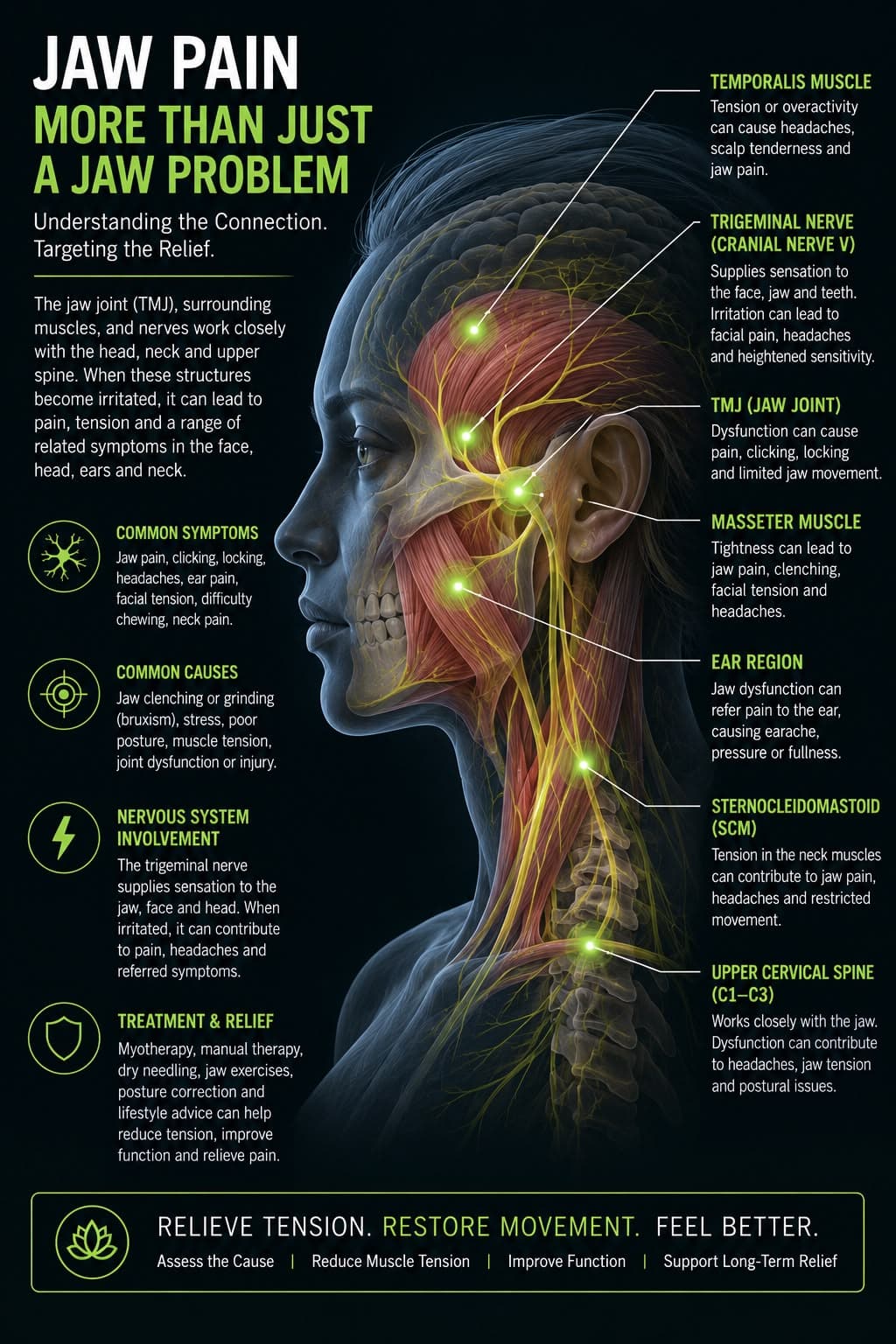
Relief from TMJ, jaw pain and facial tension
Jaw pain rarely stays in the jaw. It travels into headaches, ears and the neck — and the assessment that finds why is the one that looks at all of them at once.
MyoFitness Team · 11 min read - Myotherapy11 Oct 2026
Neck and shoulder pain from desk work: what is actually going on
It is rarely the posture itself. It is how long the same posture is held without a break — and the tissue changes that follow are treatable, usually faster than people expect.
MyoFitness Team · 8 min read - Headache & Migraine6 Oct 2026
Cervicogenic headache: when the neck is what is causing the head pain
One-sided, starts at the base of the skull, worse after a long day at a screen and unmoved by migraine medication. That combination has a name, and it is treated at the neck.
MyoFitness Team · 6 min read

