
Return to running after an ankle sprain, without spraining it again
Most ankles stop hurting long before they are ready to run. The gap between those two points is where almost every re-sprain happens.

The short version
- Up to seventy per cent of people who sprain an ankle sprain the same one again.
- Pain settles in about two weeks. The balance system that protects the joint takes far longer.
- Single-leg balance, calf capacity and hop control decide readiness — not how the ankle feels.
- A sprain that is still swollen at six weeks needs reassessing, not more rest.
An ankle sprain is the most common injury in almost every running and court sport, and the one most often called minor. It is minor in the sense that it usually heals without surgery. It is not minor in the sense that it very frequently happens again, and each time it does the joint is left a little less protected than before.
What we treat
- Acute lateral ankle sprain
- Recurrent ankle instability
- Stiff ankle after immobilisation
- Calf and Achilles compensation
- Peroneal tendon overload
- Return-to-sport readiness
Why the same ankle goes again
Ligaments do more than hold bones together. They are full of receptors that tell your brain where the joint is and how fast it is moving, and that information is what triggers the muscles around the ankle to brace before you land badly. A sprain damages those receptors along with the ligament, and they do not recover simply because the pain stops.

The reflex that needs rebuilding
The peroneal muscles on the outside of the lower leg are what stop an ankle rolling. After a sprain they fire measurably later than they did before. Balance work is not a gentle extra at the end of rehab — it is how that timing is restored.
- Single-leg stance, eyes open, then eyes closed.
- Unstable surfaces once flat ground is easy.
- Reactive work: catching, turning, changing direction.
The numbers worth knowing
of people who sprain an ankle go on to sprain the same one again.
weeks of balance and strength work is what the evidence supports, not two.
of the uninjured side is the usual benchmark before running resumes.
The four phases
You move on when you pass the criteria, not when the calendar says so.
- Phase 1
Protect and move
Days one to five. Relative rest, compression, and gentle movement within comfort. Complete immobilisation beyond the first days slows recovery rather than helping it.
- Phase 2
Restore range and load
Weeks one to three. Hands-on work for the joint and calf, weight-bearing ankle range, and calf raises built up from double leg to single leg.
- Phase 3
Rebuild balance and power
Weeks three to six. Single-leg balance progressions, hopping in straight lines, then hopping with direction changes. This is the phase most people skip.
- Phase 4
Return to running
Week six onwards, typically. Walk-run progressions first, then distance, then the surfaces and turns your sport actually asks for.
Tests before you run
Four simple checks. The injured side should be within roughly ten per cent of the other one.

Single-leg balance
Thirty seconds on the injured leg with your eyes closed, without the foot skating around for grip. Harder than it sounds, and the clearest early marker.

Calf raise capacity
Twenty-five single-leg calf raises through full range on the injured side. Compare against the other leg rather than against a target.
Single hop for distance
Hop as far as you can on one leg and land under control. Within ten per cent of the other side is the usual threshold.

Side-to-side control
Lateral hops over a line for thirty seconds. Running is straight-line; ankles roll on turns, so the test has to include them.
Ready to run, or not yet
Pain is the least useful of these signals and the one people rely on most.
Ready
- Full, pain-free ankle range in weight-bearing.
- Single-leg balance held comfortably with eyes closed.
- Calf raises within ten per cent of the other side.
- Hopping and landing feel controlled, not guarded.
Not yet
- Swelling that returns after activity.
- A feeling of the ankle giving way on uneven ground.
- Avoiding weight on the outside of the foot.
- Calf noticeably smaller than the other side.
The good news about rehab that is done properly
Completing a full balance and strength programme roughly halves the chance of spraining the same ankle again. It is one of the few interventions in sports medicine with that strong an effect, and it takes about ten minutes a day.
An ankle stops hurting weeks before it stops giving way. The gap between those two is where the next sprain happens.
What treatment adds to the exercise
Exercise does the rebuilding. Hands-on work makes the joint and the calf able to do it.

Joint mobilisation
An ankle that cannot bend forward properly changes how you land. Restoring that range early is what stops the knee and hip compensating for it.

Calf and peroneal release
The muscles that have been guarding the joint tighten and stay tight. Releasing them is what allows the strength work to be loaded properly.

Swelling management
Compression, elevation and gentle drainage work to move persistent swelling that is limiting range weeks after the injury itself has healed.
Exercise prescription
The programme is short, specific and progressed each visit. Ten minutes daily that changes every fortnight beats an hour that never changes.

Return-to-run planning
Walk-run intervals built around your week rather than a generic table, with the surfaces and turns your sport actually involves added at the end.
When an X-ray is needed first
Inability to weight-bear for four steps immediately after the injury, or bone tenderness at the back edge of either ankle bone, meets the criteria for imaging. Get that ruled out before starting hands-on treatment.
Common questions
About ankle sprains and getting back to running.
Should I be using ice?
Ice for comfort in the first day or two is reasonable, but it does not speed healing and there is no reason to persist with it. Compression and gentle early movement do more for swelling than ice does, and they are what we tend to emphasise.
Do I need a brace?
A brace or taping is useful for the first return to sport, particularly in the first season after a sprain, and there is good evidence it reduces recurrence. It is a supplement to rehab rather than a replacement for it — the balance work still has to happen.
My ankle has not been the same for years. Is it too late?
No. Chronic ankle instability responds to the same balance and strength work, it simply takes longer and needs to be more consistent. People who have been rolling an ankle for a decade routinely get a real change out of a properly progressed twelve-week programme.
Why does my calf feel tight when it was my ankle?
Because the calf has been guarding the joint since the day of the injury, and because a stiff ankle makes the calf work through a shorter range. It is one of the most common reasons an ankle that feels fine still does not run well.
Find a myotherapist near you
Every practitioner in the directory is verified before their listing goes live. Search by suburb, therapy or health fund.
Related articles
- Injury & Recovery19 Oct 2026

Why your back pain keeps coming back, even after massage.
You book a massage, walk out feeling looser, and a week or two later the same ache is back. It's one of the most common stories therapists hear. Here's what's usually going on, and what tends to make a longer-lasting difference.
MyoFitness Team · 7 min read - Myotherapy11 Oct 2026
Neck and shoulder pain from desk work: what is actually going on
It is rarely the posture itself. It is how long the same posture is held without a break — and the tissue changes that follow are treatable, usually faster than people expect.
MyoFitness Team · 8 min read - Jaw & TMJ7 Oct 2026
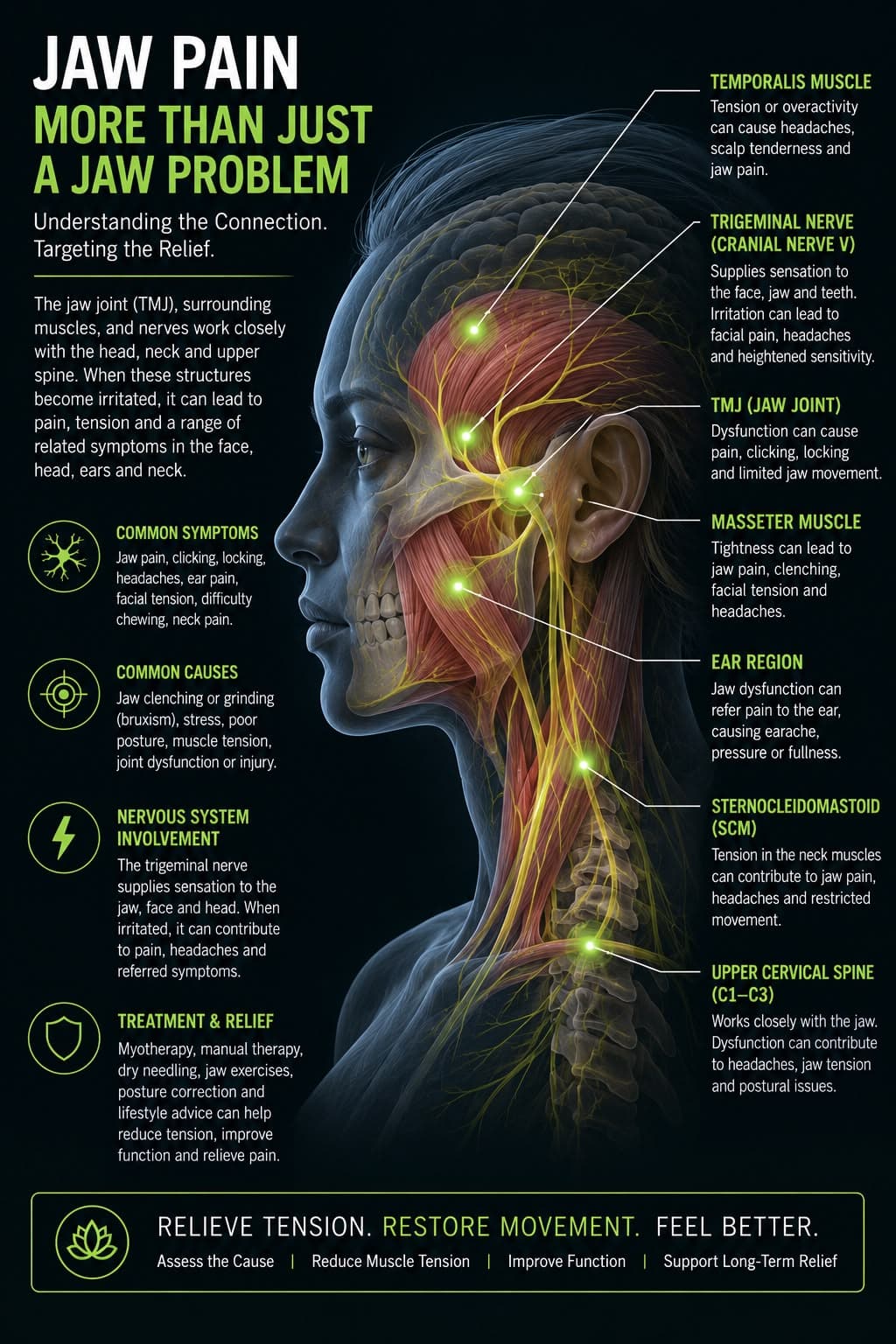
Relief from TMJ, jaw pain and facial tension
Jaw pain rarely stays in the jaw. It travels into headaches, ears and the neck — and the assessment that finds why is the one that looks at all of them at once.
MyoFitness Team · 11 min read
